Showing posts with label experiments. Show all posts

Wednesday, September 28, 2011

Wednesday Weekly Website–Exploriments


Exploriments

2011-09-26_1650

Review: Exploriments is a site that has interactive simulations that help students learn and understand math and science.They get to explore different topics and ask, and answer, questions like "what-if" and find the cause and effect of things. There are learning objectives for each Exploriment and everything works together and builds on previous knowledge. The Exploriments are organized by three subjects: Physics, Chemistry and Math and then further organized by topic. The free access does not give you full features, but there are some great things to use. You can upgrade to the premium access if you want to.

2011-09-26_1658

Suitable for ages:7-15

Friday, January 14, 2011

CSIRO Science by Email

CSIRO or The Commonwealth Scientific and Industrial Research Organisation is Australia's national science agency. Their website is quite full of scientific articles and researches, and their magazine Double Helix and Scientrific look quite good (though available only in Australia). But what I want to share with you today is their Science by Email free newsletter. it is:

a weekly email newsletter featuring science news and activities.

Science by Email delivers the world's best science direct to your inbox. It contains:

  • the latest science news

  • fun activities and experiments

  • environmental insights

  • a quiz

  • SCOPE TV previews

  • the best science websites

  • occasional competitions

  • upcoming events.

2011-01-14_0928

The quiz, news and other stuff is also quite educating but I love their experiments and activities section the best. Every week you get to do a experiment with things commonly found in home and grocery store, topics varying from mechanics to light. Each experiment is simple to do and is followed by scientific explanation in easy to understand language. If your learner is interested in that topic, related learning links are also included. And best of all it is completely free. Do give this newsletter a try.

Thursday, November 11, 2010

Few Things To Do With Pizzas

When we talk about Pizza and learning all that comes to mind is fractions. No doubt pizza comes in really handy when teaching fractions but there is so much more you can do with this all time family favorite. So here are just a few ideas.


2010-11-11_1354

1. Use pizzas as creative writing starter.


2010-11-11_1357

2. Use your local pizza shops to introduce components of spatial organization with this interesting lesson plan.


2010-11-11_1417

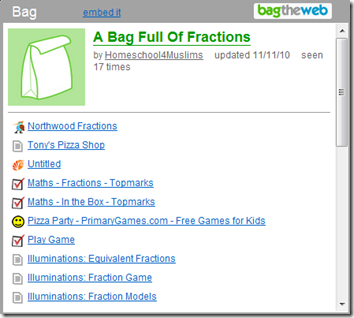
3. Fractions, of course, may be using one of the pizza game from this Bag Full Of Fractions?


2010-11-11_1441

4. Research about the history of pizza and make a flip book or timeline to show your results.


2010-11-11_1447

5. Do some science by looking at the ingredients in pizza base. Learn about wheat, explore gluten and yeast and do some experiments using yeast.


2010-11-11_1504

6. Explore your toppings like meat and cheese, dig deeper into how sausages are made and the biology behind cheese. You can also try making cheese at home and compare it with the store bought version.



2010-11-11_1507

7. Talking about pizza, which country comes to mind? Italy! So why not research about Italy and make a fact file?


2010-11-11_1511

8. Practice persuasive writing by making a poster for your very own pizzeria.


2010-11-11_1516

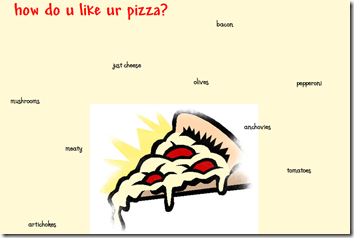
9. Now that you have enough (or more than?) knowledge about pizzas, why not present it with a digital poster?


2010-11-11_1527

10. And don’t forget to make your own home made pizza or perhaps you will like a Chicago style deep dish stuffed pizza ?

Wednesday, December 2, 2009

Wednesday Weekly Website – Hunkin’s Experiments


Hunkin’s Experiments


blog-he

Review: From making onions glow to growing ant colonies, this website has got a large number (over 200 to be exact) experiments, most of them requiring only house hold objects. Though some of the experiments are not what i call experiments but some are really good and simple. All experiments are illustrated as cartoons and it makes this website different from other science websites.

Suitable for ages: 8-80 (in the author’s opinion)

blog-he

Related Posts with Thumbnails