Showing posts with label materials. Show all posts

Wednesday, June 29, 2011

Wednesday Weekly Website–Nobelprize Education


Nobelprize Education

2011-06-27_1354

Review: While I do not agree with the criteria based upon which nobelprizes are given, (recent nobleprizes for peace, for instance) there is some very good educational material available on their website at Nobelprize Education. There are animated games and simulations, based on Nobel Prize-awarded achievements, that will teach the concepts in a fun and inspiring way. There are games and simulations on tons of topics. Some of the games are easy enough for early elementary aged children, while some are geared to more advance topics. Through these games children can learn things like what is a blood type, how immune system works, what are x rays, how is malaria cured, what is DNA, understand insulin and diabetes, what are conductive polymers, what is genetic code, to name only a few. I haven’t seen all the games/simulations so I don’t know about music etc, but the ones I have seen didn’t have music and they were quite straightforward and easy to understand. Use this site as an aid when teaching any of the topics or on its own. Take your time exploring this wealth of knowledge, as speeding through it can be a bit over whelming for some non-scientific learners.

2011-06-27_1353

2011-06-27_1352

Suitable for ages: 8-18

Wednesday, April 6, 2011

Wednesday Weekly Website–The Scilands


The Scislands

2011-03-14_2020

Review: The Scislands is a great resource for scientific studies. It helps to promote greater understanding and awareness of science and technology making that experience fun, interactive, and relevant. Children can choose from one of many “scislands” or scientific islands. Each island holds experiments or fun activities to try on topics like reactions, forces, light, math, nature, space, humans and inventions. The resources are very original and can be used for learners as young as toddlers and as old as teenagers. These resources can also be used as mini lesson units on these topics as they also include the explanation of processes involved.

2011-03-14_2022

Suitable for ages: 3-15

Friday, March 25, 2011

Few Things To Do With Toys (part II)


This is second part of Few Things To Do With Toys. The First Part was about using toys in literacy. In this part I have gathered some ideas on how to use toys in STEM (science, technology, engineering and math) and history.

STEM with Toys
2011-03-25_1100

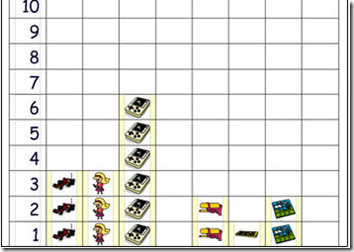
1. Children can do surveys among family and friends of favorite toys and represent the data in graphical format. You can use this pictogram if children are not comfortable making bar graphs yet.


2011-03-25_1041

2. In Toy Repair Man, children will need to decide on the correct tool to repair the toy. 


2011-03-25_1044

3. Gather some toys and talk about what are they made from. Discuss the properties of materials. Brainstorm words like shiny, smooth, hard, soft etc. Challenge the students to find other things in the house made of that same material. You can take the activity further by sorting toys in groups like hard and soft, shiny and dull, fabric and plastic etc. You can also use this describing toys activity after doing the same for real world toys.
 

2011-03-25_1052

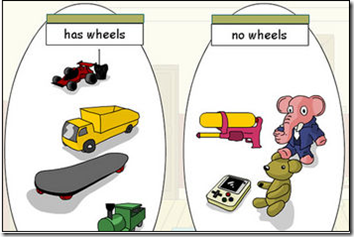
4. Use the same toys from step 3 or gather some more. Talk about if and how the toys move. You can again sort the toys in groups of movable and non movable toys. You can use this toy sorter to sort toys with and without wheels.
 

2011-03-25_1059

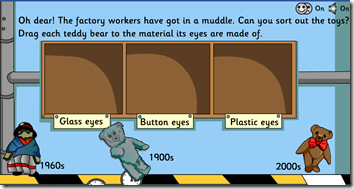
5. Using this activity children can look at when teddy bears, dolls and cars were made and what they were made of.


2011-03-25_1116

6. Making Scientific toys is one sure way to spark interest. There are a lot of benefits in these kinds of toy making. Not only is it a fun way to spend quality time with your child, it increase their interest in science and math, give them a better understanding of why science and math are important in everyday life (applied science and math) and increase their problem solving and designing skills. Try making some simple toys from Science Toymaker and if the child is interested follow the “whys” behind these toys.


History with Toys

2011-03-25_1105

1. Look at these pictures of toys together with your child. Discuss how toys have changed. Try to guess the time by looking at the pictures of toys.
 

2011-03-25_1106

2. Look at the history of some of the famous toys like Lego here.


2011-03-25_1027

3. Children can sort new and old toys. Talk about why your child thinks a toy as old or new. What things does he/she look at. Carry on to describing the toys.


2011-03-25_1110

4. Iboard has some very good resources for history using toys. Kids can compare toys of today with toys of past. They can also sort toys into piles of new and old toys. There is also a toy time line available where children can place toys according to their time of invention.


2011-03-25_1056

5. You can look at how teddy bears have changed over the years and find the differences between your toys and your grandparents toys here

Wednesday, September 15, 2010

Wednesday Weekly Website – Factory Days


Factory Days

image

Review: Children assume the role of a factory worker in this fun interactive game. They have to decide if the material whose delivery truck has arrived is suitable for the factory they are working in. They have to receive deliveries for an ice cream factory, paper factory, cheese factory, glass factory etc. A fun way to learn which materials are used to make different things. Many things may seem easy to decide such as milk for the ice cream factory but things like sand for glass factory may seem irrelevant to young learners. Engaging graphics and easy interface makes it suitable for even very young learners, but there is music in the back ground so you will need to turn the speakers off.

image

suitable for ages: 4-7 years old.

Related Posts with Thumbnails